

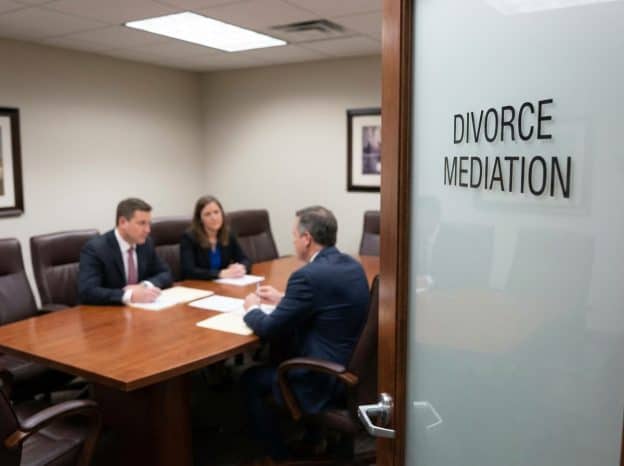
The divorce mediation process follows six stages: consultation, financial disclosure, negotiation, agreement drafting, attorney review, and filing documents with the court. Most straightforward cases require three to six sessions, and the process takes place over two to four months.
Divorce mediation replaces a more expensive and demanding alternative that requires hiring independent lawyers (double the cost) and a longer litigation process. If you have a more complex situation, such as one where there is high conflict and minimal trust, you own a small business, there is a history of domestic abuse, or one person is hiding assets, mediation is not the right option for you.
With divorce mediation, you work with one divorce mediation professional (optimally, a family law attorney specializing in mediation). It is best for couples who are largely in agreement, with fairly standard assets, and who want to keep things as streamlined, affordable, and stress-free as possible.
⚠️ Legal Disclaimer
This article provides general information about the divorce mediation process in California but does not constitute legal advice. Every case is different, and outcomes depend on your specific circumstances. Before making decisions about mediation or divorce, consult a licensed family law attorney in your state.
The Six Stages of Divorce Mediation
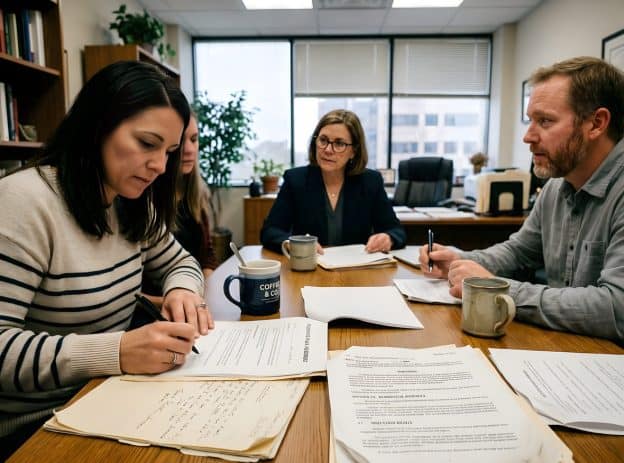
Typically, what happens during divorce mediation is that couples meet with their divorce mediator over a series of Zoom sessions. Divorce mediation follows a structured, multi-stage process that can take as little as two months and rarely requires more than 12. Throughout this process, the divorce mediator is a neutral party who facilitates discussions and clarifies certain legal issues or precedents, but does not make decisions for either party.
The first stage is the consultation. This is a no-obligation meeting where both parties meet with the mediator, discuss their overall goals to make sure mediation is the right step for them, and learn more about the divorce mediation process. If you decide to move forward with mediation, you’ll leave that first consultation with links to California’s standard divorce documents to begin the legal dissolution of marriage, as well as instructions (and support) as you move forward.
The second stage requires a financial disclosure process. The financial disclosure forms include information about your household income, combined and individual debts, and all financial assets held by both parties and each individual. California is a community property state, and this rule means that all of the assets acquired by either party during the marriage are split 50/50. This excludes anything you had prior to the marriage, as well as family inheritances. The mediator can help to explain which assets are considered joint and which would be excluded from the community property rule. In addition to facilitating the legal division of assets, the courts also use this financial information to determine spousal and/or child support.
After the financial disclosure process, we move on to the third stage of divorce mediation: negotiation. During this stage, couples agree on four main topics: asset division, spousal support, child support, and visitation. It’s not uncommon for couples pursuing divorce mediation to have minimal negotiations. This is especially true if they have easily divisible assets and largely agree on child custody and support terms. If there are issues that need to be worked through to reach a complete agreement or a satisfactory compromise, the mediator serves as a neutral facilitator of those conversations. We never provide legal advice. If you reach an impasse, we can take a break and meet again when both parties have had time to think or process. We may also re-engage the conversation, looking at it from various angles. After more than 40 years helping couples negotiate through the mediation process, I never provide binding legal advice, but I can provide insight into how a judge is most likely to rule if it were to go to court.
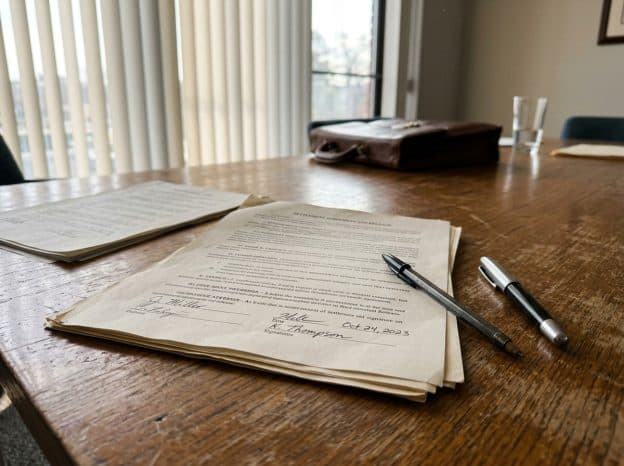
Assuming the negotiation process is successful, we move on to drafting the marriage settlement agreement (MSA). That’s the document where all of the agreements made during negotiations are officially recorded for the court’s record. It contains the comprehensive, legally binding terms and resolutions agreed upon by divorcing spouses. It’s essential that you feel 100% confident with the final terms because you are beholden to them by the court. If you do not honor them, it can come back to haunt you and may require hiring lawyers to pursue litigation.
If you can afford it, we recommend pursuing an independent attorney review, which typically costs $1,000 to $2,000. This is a non-adversarial review done by individual lawyers (one per party), to ensure the terms of your divorce feel fair and provide room for the legal equivalent of “a second opinion” before the MSA is officially filed with the court.
Finally, the MSA is filed with the courts, which is the sixth and final stage. From that point forward, the agreements are legally binding, and both parties are expected to adhere to the agreements. That said, there is a mandatory six-month waiting period during which you are still technically married. This gives both parties space to make sure the agreement terms are the right choice for them and provides a window of time in case the couple decides to remain married.
Although the mediation process is divided into six stages, it’s still much faster than a divorce through litigation. While mediation tends to resolve a divorce within two to four months, California couples using litigation typically complete their final MSA between 12 and 24 months.
How Many Sessions Does Divorce Mediation Take?
There is no set rule regarding how many sessions a divorce mediation takes. Most couples meet with their mediator at least twice: once to discuss the process and their goals, and again during the negotiation phase. Zoom mediation sessions are legally valid for California divorce proceedings, so keep in mind that these sessions do not require you to commute any further than your own home or office. After the initial consultation, mediation sessions take 2 to 3 hours each. You can also sign all legal documents online via DocuSign.
However, mediation proceedings can take longer depending on the complexity of the case or big differences of opinion regarding child custody, support, or visitation terms. Usually, a straightforward mediation process requires two to four visits, and it may be completed in two months or less. If there are moderate complexities, but couples are still largely on the same page, it can take three to six sessions (over two to four months). If there is a higher level of complexity or a couple is struggling to find common ground, mediation may require six or more sessions.
ℹ️ Session Count Varies by Complexity
Most straightforward divorce mediations take three to six sessions over two to four months. Simple cases with easily divided assets and no children can wrap up in as few as two visits, while higher-conflict or more complex cases may need six or more. Every session takes place over Zoom, which is legally valid for California divorce proceedings.
If communication breaks down, agreements can’t be reached, or more complex issues arise during the process, there are options. We may refer you to a collaborative divorce attorney or pursue a more traditional litigation path. In this case, we can maintain the agreements you’ve made in the MSA and draft a document for both of your attorneys, letting them know what remains unresolved.
What the Mediator Covers (and What Only You Can Decide)
While the best mediators tend to be family law attorneys, they serve as neutral parties during mediation sessions and within the framework of communication between the parties and the mediator. Mediators do not provide legal advice, and they do not decide anything at all.
Instead, mediators facilitate conversations between both parties around four core issues:
- Property and debt division under California’s community property rule.
- Spousal support (this is based more on facts than any formula).
- Child custody and a co-parenting plan.
- Child support (using California’s guideline formula, parties can agree on specific terms).
In addition to not giving legal advice or making binding decisions, California divorce mediators can shut down the process if they find that one party is hiding assets. This is illegal and moves the divorce into the litigation realm, which requires individual attorneys. We also bow out of the process reveals there is a history of domestic violence of any kind.
⭐ Key Takeaway
Mediation only works when both parties can negotiate in good faith. If there’s high conflict, a shared business, a history of domestic abuse, or one spouse hiding assets, a mediator will step back and the case moves toward litigation instead. The real question isn’t whether mediation is cheaper or faster, it’s whether your situation is a good match for it in the first place.
What Mediation Costs Compared to Divorce Litigation
On average, mediation costs significantly less than litigation. However, the costs vary depending on the complexity of the case.
The average cost for mediation ranges from $3,000-$15,000 combined, versus $15,000-$50,000+ per spouse in litigation. Couples who choose mediation but opt for an attorney review of the MSA, protecting each party without requiring full litigation representation, may pay an additional $1,000 to $2,000.
Getting Started With Divorce Mediation
To reap the benefits of divorce mediation, which include a streamlined process, lower overall costs, and a shortened timeline, we recommend seeking support from an experienced family law attorney. Gerard A. Falzone, founder of the Law Offices of Gerard A. Falzone, has more than 40 years of experience in California family law mediation.
All sessions are conducted via Zoom, allowing us to serve clients throughout Alameda and Marin County without time lost to unnecessary commutes. You can schedule a free telephone consultation by calling (510) 521-9500 to determine whether mediation is a good fit for your situation, after which we’ll schedule your first mediation consultation to get the process underway.
🎯 Wondering If Mediation Is Right for You?
Every divorce is different, and the best way to find out if mediation fits your situation is a conversation. Schedule a free telephone consultation with Gerard Falzone by calling (510) 521-9500. All mediation sessions are conducted over Zoom, so you can work with us from anywhere in Alameda or Marin County.
Frequently Asked Questions About Divorce Mediation
Q1: How long does divorce mediation take in California?
A1: The simplest cases take between one and two months. Divorces with more complex scenarios or where couples struggle to come to agreement on core divorce terms (asset division, child custody/visitation, etc.) can take as long as 12 months. Even so, that is still far shorter than a divorce using individual representation and litigation, which averages between 12 and 24 months.
Q2: How many sessions does divorce mediation require?
A2: The average divorce using mediation requires three to four sessions. Some can be completed in just two sessions, particularly if there is a simple division of assets/debts or no children are involved. The most complex mediation scenarios can take six or more sessions, but that is more rare.
Q3: What is a marital settlement agreement?
A3: A marital settlement agreement (MSA) is a written contract between both parties that states how they have agreed to handle the pertinent aspects of their divorce. It typically covers things like:
- Property division: This portion covers how they’ve decided to split houses, additional properties, cars, bank accounts, retirement funds, investments, and debts.
- Child custody and visitation: Documents specific to child custody establish the schedules for visitation and parental duties. It can also outline a right of first refusal to have your child if the other parent isn’t able to take care of them during their typical evening or weekend.
- Support (spouse and/or child): This section covers the amounts for child support and alimony, the former of which is usually determined by CA’s child support calculator while the latter is determined by the receiving spouse’s need, situation, history, and future earning capability.
- Expenses: Some couples use their MSA to outline specifics about future expenses, such as how they’ll handle expenses beyond a child’s basic needs, future college tuition, pet care for existing pets, and so on.
Once complete, the MSA is filed with the court. The divorce is final six months after the file date stamped by the court.
Q4: Do I need a lawyer for divorce mediation?
A4: No, divorce mediators come from a diverse range of backgrounds. However, nobody understands the ins and outs of California divorce laws like a licensed attorney.
We strongly advise using a family law attorney specializing in divorce mediation for the best outcomes. If you choose to use someone else, then having the documents reviewed by independent attorneys is a must to ensure there are no mistakes or serious oversights.
Q5: Can divorce mediation be done over Zoom in California?
Yes. Zoom mediation sessions are legally valid for California divorce proceedings.




 The holidays are