
⚠️ Legal DisclaimerThis article offers general information about co-parenting mediation and California family law. It is not legal advice, and outcomes depend on the specific facts of each case. Before making decisions about custody, visitation, or mediation, consult a licensed California family law attorney about your situation.
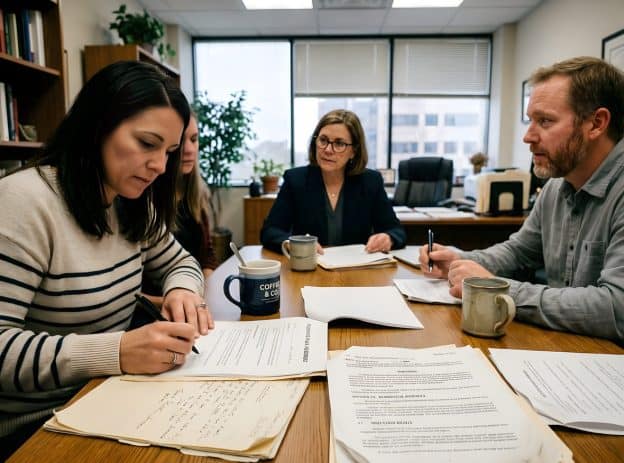
Co-parenting mediation uses a single family law professional as a mediator, while couples work together to create or update parenting plans during or after a divorce. Mediation can also be used for unmarried couples as they navigate child support, custody, visitation, and other aspects of collaborative parenting plans.
During the process, a neutral mediator helps separated or divorced couples create an agreement that honors the best outcomes for all, to minimize tension, drama, and excessive costs associated with retaining separate lawyers or battling things out in the courtroom.
While co-parenting mediation can be one aspect of divorce mediation (which covers all divorce issues), it also exists as a stand-alone service. And, because people’s plans and lives change and evolve, co-parenting mediation can take place at any time after a divorce while the children are minors.
What Gets Covered in a Co-Parenting Mediation Session
While co-parenting sessions are tailored to the parent’s needs, the agreements made typically revolve around things like:
Child Custody Schedules
When we discuss child custody schedules, we evaluate factors such as the children’s ages, parents’ work schedules, and how to keep family culture and certain traditions as stable as possible for the kids. If the children are old enough, they may want to have input on the custody schedule.
Some of the most common structures for child custody calendars are:
- 2-2-3 rotation. Parents alternate two days on/two days off/three days on. This is common for parents of babies or very young children, who need to maintain consistent bonding, since this age group can’t understand explanations about what’s happening.
- One week on/one week off. As children get older, they sometimes request a two week/two week schedule to minimize transition between homes, which is almost always challenging.
- The 2-2-5-5 rotation. With this one, children spend two days with one parent, two days with the other, then five days with the first parent, and five days with the other.
- The 3-3-4-4. This schedule is like the 2-2-5-5, but it’s done with three/four days in between.
Holiday and vacation planning
It’s not uncommon for families to alternate holidays. However, there may be more detailed agreements depending on a particular parent’s tradition or which extended family members will be present. It’s always important to include agreements on how permission for travel is granted, especially when plans involve out-of-state or out-of-country destinations.
Education & Medical Decisions
Who will be deciding what, and how will disagreements be handled?
Parent Communication
Clear communication guidelines are essential to keep things consistent and respectful for all. Your child custody agreement should outline preferred communication methods and time boundaries, such as “changes to the custody schedule need to be requested at least one week in advance” or “requests or questions need to be responded to in 24 hours or less.”
We usually recommend using co-parenting apps like OurFamilyWizard, Cozi, or AppClose. These apps are tamper-proof and offer secure logins, access to shared family calendars, communication platforms, and more.
Shared Child-Rearing Values & First-Right of Refusal
Co-parenting mediation sessions are also a time for you to prioritize certain child-rearing values you can both agree on, realizing there’s no way to control what happens in the other household completely. You can also stipulate things like “first-right of refusal,” which means if a parent is going out on a certain evening or will be gone for a day on a business trip, the other parent has the first dibs on having the child with them before a babysitter, step-parents, or anyone else would watch them.
Again, sessions are personalized. While the above are among the most common issues we address during co-parenting mediation sessions, there may be others relevant to your family’s situation.
How California Law Shapes Co-Parenting Agreements
Co-parenting mediation sessions create agreements that follow CA Family Law child custody tenets. Three of the statutes we pay closest attention to are:
- FC 3020: CA’s presumption of frequent and continuing contact with both parents. Barring things like domestic violence, child abuse, or unaddressed substance abuse, CA law is very clear about prioritizing a child’s consistent contact and connection with both parents. Mediation aligns naturally with this statute since parents are working together (win!) to create co-parenting agreements that keep children’s wellbeing at the forefront.
- FC 3011: This law emphasizes that the courts will always prioritize the best Interest of a child whenever parents can’t agree about a particular child custody or visitation issue.
- FC 3170: If you end up in court anyway, the court requires mediation anyway. By starting with private mediation, you have more control over the mediation you work with and the process from the outset.
Here in Alameda and Marin, county law courts use mediators to make direct custody recommendations to the judge. Private mediation bypasses this. If you and the other parent disagree, the co-parenting mediator lets you know how the judge would most likely rule, which can help you come to a faster resolution. Also, mediated child custody agreements can include a built-in clause requiring a return to mediation before either parent files a court motion.
ℹ️ California Law Favors Both ParentsUnder Family Code 3020, California presumes that children benefit from frequent and continuing contact with both parents. Co-parenting mediation works with that presumption rather than against it, because both parents help shape the plan instead of a judge imposing one.
When Co-Parenting Mediation Makes Sense After Divorce
A recent 12-year study demonstrated that parents who mediated custody maintained contact with children at three times the rate of those who used litigation. That’s worth considering. But even if you didn’t use mediation during your initial divorce proceedings, you can still benefit from co-parenting mediation long after the divorce is final.
There are several scenarios where co-parenting makes sense after a divorce. Time brings inevitable changes for both parents, their households, their incomes, and their children’s development. And, you can use co-parenting mediation after a divorce, even if you used litigation during the original divorce proceedings.
Here are some of the scenarios that inspire clients to return to our office for post-divorce co-parenting mediation or support.
- Parent relocations. While the courts encourage parents to remain as local as possible to minimize disruptions in their custody/visitiation schedules, a relocation may be unavoidable. This may require redrafting of the physical custody and visitation schedule, although both parents maintain 50/50 legal custody.
- Changes in the child’s school. It’s not uncommon for children to go to schools outside of their original school district, especially if they’re taking advantage of opportunities available via charter, magnet, or private schools. In this case, it may make more sense for a parent who lives closer to the school to have a larger share of the child-custody pie to keep school/extracurricular commutes reasonable.
- A parent’s work schedule shifts considerably. If a parent starts working graveyard shifts or has to be at work far earlier than a child starts school, it may change which household makes the most sense on weekday evenings. Similarly, a parent may need to work out of town regularly, which would shift custody to the other parent’s home.
- The children’s needs evolve with age. Some children are far more mother-attached than others, and the other parent may concede during that phase to allow the mother to have a larger share of the physical custody. Or sometimes a teen needs more space from the parent with whom they have the most conflict. The adolescent’s or teen’s physical location relative to their social community, or their aversion to too frequent transitions, may also prompt parents to create new custody arrangements that better support the child’s needs.
Fortunately, an existing court order can be modified through mediation, after which a stipulated child custody modification is filed with the court. This process prevents you from having to hire lawyers or return to a costly litigation process.
How to Get Started with a Co-Parenting Mediator
Getting started with a co-parenting mediator is as simple as making a phone call, determining whether your situation is a good fit for co-parenting mediation, and scheduling your first appointment.
During that first consultation, both parents typically meet (together or separately) to explain their situation and goals and to explore whether it feels like the right fit. Here at the Law Offices of Gerard A. Falzone, we use Zoom consultations to make it as easy as possible for clients to meet with us around their busy work/life schedules. With 40+ years of California family law experience, we ensure our clients move through the process as efficiently as possible, minimizing time and expense.
Co-parenting mediation works best for parents who are committed to minimizing stress and willing to negotiate. It may not be the best option in active, heated divorce situations or where litigation is already in motion.
Give the Law Offices of Gerard Falzone a call at 415-482-7800 or contact us online to schedule a discovery call and learn more about your options.
⭐ Key TakeawayCo-parenting mediation is not only for couples in the middle of a divorce. Parents can use it during a divorce or years later to update a plan when jobs, schools, or a child’s needs change. The mediator guides the conversation and prepares the paperwork, but you and the other parent make every final decision about your children.
FAQ About Co-Parenting Mediation
Can we use co-parenting divorce mediation if we’re already divorced?
Yes, absolutely! In fact, co-parenting mediation is an ideal solution for couples who are already navigating post-divorce life. Now, you both have a better understanding of what’s working and what’s not, as well as how to optimize the process for the kids. This lived experience can significantly expedite the custody mediation process.
Does the mediator decide our custody schedule?
No. The mediator does not make any decisions. We are family law attorneys who prefer to work in more collaborative settings and avoid contentious litigation. Mediators are there to listen, provide professional input based on CA family law statutes, and draw up the legal paperwork we file with the court for you.
While we are happy to provide suggestions for your child custody schedule based on what you share with us, you are the ones who make all final decisions regarding the child custody agreement.
How long does co-parenting mediation take?
In most cases, co-parenting mediation takes two to four sessions, which may be spread out over a couple of weeks to a month or so. Ultimately, the parents’ ability to cooperate and negotiate determines how long it will take. In simple cases, a standard custody agreement can be drawn up in just one or two sessions. More complex cases, or couples who have a hard time getting around certain sticking points, may require extra sessions to iron things out.
What happens if we can’t agree in mediation?
Usually, our discovery session is enough for mediation attorneys to sense whether or not the process is right for you, or whether you might want to seek collaborative divorce or traditional litigation. If, however, we move forward and you can’t agree, we’ll refer you to reputable litigation attorneys in the area.
🎯 Talk Through Your SituationWondering whether co-parenting mediation fits your family? The Law Offices of Gerard A. Falzone offers a free consultation by phone or Zoom, with 40+ years of California family law experience, to help you reach a workable agreement without the cost and strain of court.