
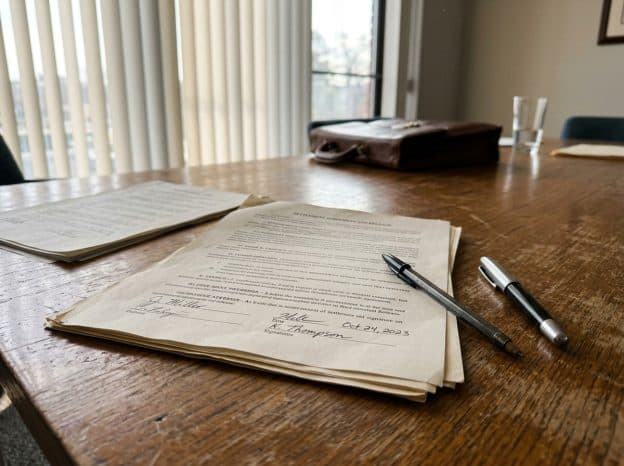
California is a no-fault state, so there’s no need for a courtroom trial to finalize a divorce. However, there is a six-month “cooling off” period for any couple filing for divorce, with or without a lawyer. Any change of mind or alteration to the settlement agreement during the state’s mandatory six-month waiting period requires refiling the paperwork, which resets the six-month clock. Similarly, if you make any mistakes completing the legal paperwork, the court will kick them back, and you’ll have to re-file, which also restarts the clock.
For this reason, we recommend working with the right type of divorce lawyer to keep costs and energy use as low as possible for your case. When you choose the right divorce lawyer, with the intention of a divorce without court, you will minimize drama and extra costs and significantly minimize the risk of having to start over and re-file.
How California Divorces Actually Work (Most Skip Court Entirely)
Did you know that almost 95% of California divorces settle without a courtroom trial? Historically, litigation was used to prove fault and to have a judge rule on what a couple couldn’t agree on. Once California became a no-fault state, it made it easier for couples to divorce without a lawyer or dramatic public courtroom displays.
By removing fault-proving, historically the prime reason to litigate, California’s no-fault law allows couples to reach a divorce settlement without an attorney. That said, we never recommend a DIY divorce because it puts you at risk of incomplete paperwork, unnecessarily heated or stressful arguments over who gets what, and a much longer divorce.
Keep in mind that divorces where each party retains an attorney cost an average of $15,000 to $50,000 compared to average costs of mediation are between $5000 to $14,000 (which is split between the two parties). Working with a mediating divorce lawyer means you can save thousands of dollars while still having a fair, finalized divorce settlement in six months.
Your Four Options for Avoiding Court in California
Here are four options for individuals or couples wondering how to avoid court in divorce or how to move through divorce settlement without attorney fees that break the bank.
- Mediated divorce. With a mediated divorce, couples meet with a divorce mediation attorney who serves as a neutral party. Rather than representing either “side,” divorce mediators sit with couples and help them come to mutual decisions around asset division, child custody and visitation agreements, and so on. Our job is to minimize stress and drama. And, as a result of this streamlined process, paperwork is completed and filed correctly, the settlement reflects the most likely outcome had your case gone to court, and couples save thousands of dollars.
- Collaborative divorce. A collaborative divorce is best for couples with a more complex financial or asset division or with certain sticking points that are difficult for them to resolve on their own. With this model, each party retains their own collaborative divorce lawyer, with the mutual intention of settling the divorce as smoothly, painlessly, and quickly as possible.
- Uncontested/pro se divorce. This could also be considered a DIY divorce process. This is recommended only if you are in complete agreement on all aspects of asset distribution, debt, child custody/visitation, and potential spousal or child support amounts. You can do all of this by using CA’s divorce self-help resources. If you go this route, it is still worth your while to have your final paperwork reviewed by a paralegal to reduce the risk of a paperwork or filing error that causes you to start the timeline all over again.
- Summary dissolution. Couples can only use the summary dissolution process if they’ve been married less than five years. CA family law defines a summary dissolution as, “a simpler way to end a marriage or domestic partnership for couples who qualify and are able to work together. A summary dissolution becomes final 6 months after you file with the court.”
Mediation is by far the most common and broadly applicable way California couples can divorce without attorney representation in court. The other three are only recommended in very specific scenarios.
When Uncontested or Summary Dissolution Makes Sense
We mentioned that collaborative divorces are best for couples with more complex financial, business, or child custody situations. Uncontested or summary dissolution are on the opposite end of the spectrum. They are best for people who’ve only been married a short time and have no children. The ability to move forward with simple finance and asset division also makes this option more streamlined.
Both parties should be in complete agreement, without a shadow of a doubt, before filing for an uncontested or summary dissolution. Remember, once the paperwork is filed, there is a six-month waiting period. If either of you is on the fence and changes their mind about a decision during that six-month window, the paperwork must be redone, refiled, and the six-month clock starts all over again.
There is strict, FLC 2400 criteria that must be met to move forward with this type of divorce, and most couples don’t qualify. What a “divorce without a lawyer” really means is that you do all of the paperwork, serving, and filing on your own. However, it’s usually wise to invest a small amount to have a legal professional (such as a paralegal or mediation lawyer) review the documents and ensure they’re filed correctly.
Why Mediation Works Even When You Disagree
Choosing mediation does not require full agreement on the terms of the divorce. The agreement between the two of you is that you want to choose the most effective and affordable divorce, without court, and with the least amount of stress or drama. If you disagree on other aspects of the divorce settlements, that becomes a starting point for our conversations.
Just a reminder: the mediator’s role here is as a neutral guide. They are never the decision maker. You and your ex are the final decision makers. However, your mediator can provide you with best practice recommendations that align with the most current CA family law standards.
The divorce stats show us that as many as 85% of couples who choose mediation reach agreement through the process. Also, worth nothing, couples who use mediated divorces return to court at lower rates than those who pursue litigated divorces. Only 21% of those ever return to court, vs. nearly 40% of couples who go back to court after a litigated divorce.
Another reason mediated divorces are becoming increasingly popular is that the entire settlement process can be completed regardless of where each person lives. Currently, Gerard Falzone conducts all of his divorce mediation sessions via Zoom. As a result, there’s no need to navigate Alameda or Marin County traffic to get back and forth between attorneys’ offices or the courts.
Ready to See If This Fits Your Situation?
There are multiple paths to avoid court in a divorce or to reach a divorce settlement without attorneys. Taking advantage of free telephone consultations is the best way to determine which path makes the most sense for your situation.
For more than 40 years, the Offices of Gerard A. Falzone have helped to keep divorces out of courtrooms, as reasonably, amicably, quickly, and as inexpensively as possible. Our mediation services are adaptable to a range of scenarios. Contact us to schedule a free telephone consultation. We’ll listen to your story and determine whether mediation is the logical divorce option for you.
FAQ Section
Can I get divorced in California without hiring an attorney?
Yes. In certain circumstances, usually when you’ve been married for less than 5 years or don’t have children, where you can get divorced without hiring an attorney. However, if you choose this route, it’s in your best interest to have a family law professional review your final paperwork to ensure you haven’t made any mistakes. If the court identifies any errors on your DIY divorce paperwork, they will kick the papers back to you and you’ll have to start the whole process over again.
What is the difference between mediation and collaborative divorce?
With mediation, you split the costs to retain one divorce attorney who serves as a neutral party. They facilitate the marital settlement conversations, but they do not make any suggestions for you. A mediation attorney completes the paperwork, so you are assured it’s filed accurately, and they usually file the paperwork for you.
In a collaborative divorce, each person hires their own attorney. However, these attorneys have a niche collaborative divorce practice, which is inherently created to minimize friction and expedite the divorce settlement agreement with as much cooperation and ease as possible between both parties.
How long does divorce take in California without going to court?
Once you’ve filed all of the paperwork relevant to your divorce, including the financial discovery, agreements about debt and asset distribution, child custody/visitation, support payments, etc., there is a six-month waiting period. Assuming all of the paperwork was completed correctly, and neither party changes their mind, your divorce is final six months after the date you filed the documents.
What is a summary dissolution and who qualifies?
A summary dissolution is a very specific type of divorce and can only be utilized by couples who’ve been married less than five years, have no children/dependents, and very simple finances.
Is a mediated divorce agreement legally binding?
Absolutely. In a mediated divorce, the mediator is a family law attorney who drafts a Marital Settlement Agreement that, once filed with the court, carries the same force as a court order.